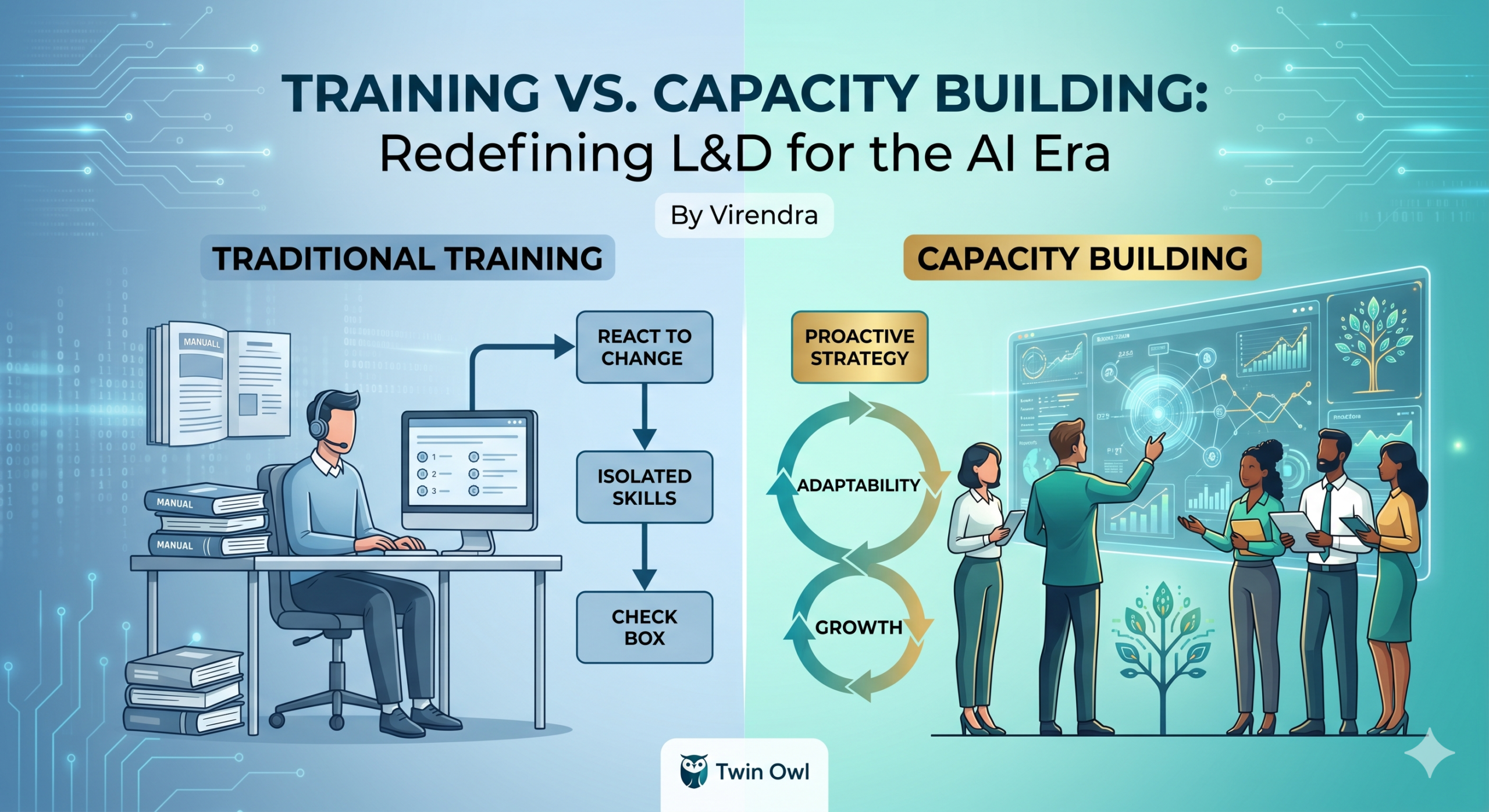
For decades, the corporate world has treated learning and development as a contained event. A new software rolls out, and employees are sent to a half-day workshop. A compliance update is mandated, and everyone clicks through a standardized slide deck. We have called this “training,” and for a long time, it was sufficient to keep businesses moving forward.
But the landscape has fundamentally changed. The rapid integration of Artificial Intelligence into our daily workflows has exposed the severe limitations of this traditional model. We are no longer dealing with static tools that remain unchanged for years. We are working alongside dynamic, rapidly evolving systems.
In this environment, teaching someone a single, isolated skill is an exercise in futility. By the time the training module is designed, approved, and delivered, the technology has already updated. What organizations need today is not more training. They need capacity building.
To thrive in the AI era, we must redefine how we approach learning. We need to move away from checking boxes and start building resilient, adaptable teams capable of critical thinking and continuous growth.
The Trap of Traditional Training
To understand why a new approach is necessary, we must look at where traditional training falls short in modern, fast-paced environments.
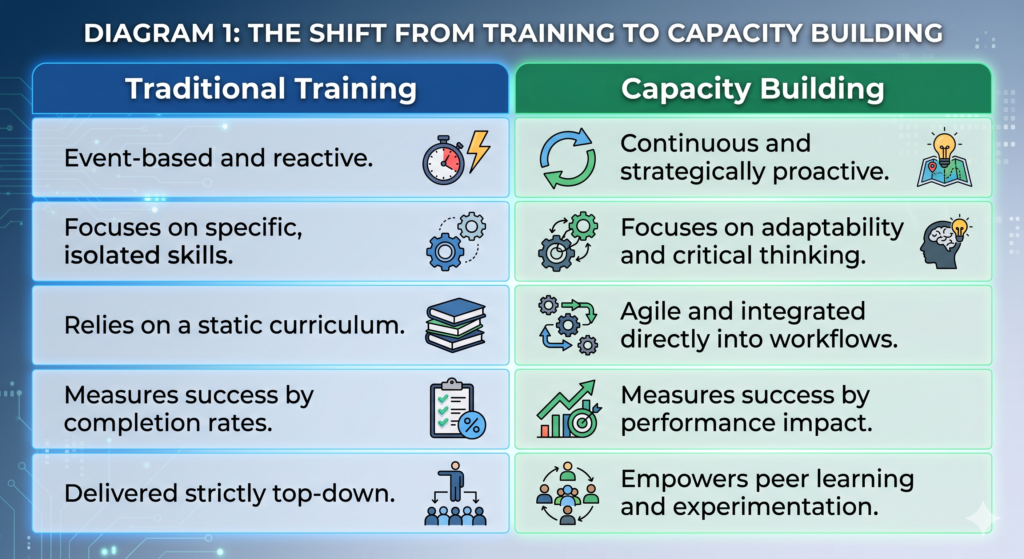
Most conventional training programs are purely reactive. They are designed to fix an immediate problem or transfer a specific set of instructions. This creates a transactional relationship with learning. Employees attend a session, absorb a predefined set of facts, and return to their desks, expected to execute perfectly.
This model treats the workforce like a machine that just needs a software patch. From an organizational psychology perspective, this approach is deeply flawed because it ignores human motivation and cognitive load. It isolates learning from the actual context of daily work.
When people are given isolated training without understanding how it connects to the broader goals of their role or the organization, engagement drops. They view the training as an interruption to their real work rather than a valuable tool for professional growth.
Furthermore, traditional training rarely accounts for the speed of modern technological change. Consider a fast-paced digital publishing or news environment. A major algorithm update occurs, fundamentally changing how content is indexed and discovered. A traditional training response would be to schedule a team seminar two weeks later to discuss the new rules. By that time, the opportunity is lost, traffic has plummeted, and the business suffers. The team needed immediate, integrated knowledge, not a delayed seminar.
We cannot solve dynamic, complex challenges with static, rigid training models. We must rethink the foundation of how organizations develop their people.
Understanding Capacity Building
If training is about transferring a specific skill, capacity building is about developing the underlying potential to acquire any skill.
Capacity building focuses on strengthening an organization’s ability to achieve its goals by developing the comprehensive competencies of its teams. It is not an event; it is a continuous, embedded process that builds resilience.
When we focus on capacity building, we are not just teaching an employee which buttons to click on a new AI dashboard. We are teaching them how to evaluate the AI’s output, how to integrate the tool into their specific workflow, and how to adapt when the platform inevitably changes its interface next month.
This approach shifts the focus from the tool to the individual. It empowers employees to become proactive problem solvers. It gives them the cognitive flexibility to navigate ambiguity and the confidence to test new solutions.
Capacity building encompasses the design of agile learning frameworks. It means integrating learning moments directly into the flow of work. It requires a shift from measuring mere activity—like module completion rates—to measuring actual performance outcomes and business impact.
A team with high capacity does not wait for a formal training session when faced with a new challenge. They have the resources, the psychological safety, and the mindset to experiment, learn, and adapt in real-time.
Why the AI Era Demands Adaptive Capabilities
The introduction of AI into the workplace is not just another software rollout. It is a fundamental shift in how work is executed. AI assumes the burden of routine, repetitive tasks. It can draft reports, analyze large datasets, and automate scheduling with incredible speed.
As a result, the human tasks that remain are the ones that require high-level cognitive skills. We need people who can strategize, empathize, negotiate, and innovate. These are not skills you can easily teach in a one-hour seminar or a multiple-choice quiz.
Organizations often make the mistake of responding to AI by creating generic “AI Literacy” courses. They put together workshops that discuss abstract concepts of machine learning or provide basic prompt templates. These initiatives frequently fail to create meaningful change because they are disconnected from the daily reality of the employees.
Without deliberate, integrated learning design, AI simply becomes a new layer placed on top of old, inefficient habits.
To truly harness these technologies, L&D must translate broad technical capabilities into role-specific applications. For instance, an operations team does not need a lecture on large language models. They need guided, hands-on support to build automation for their specific routine reporting.
This requires professionals to act as strategic partners. They must look across departments, map out where workflows are breaking down, and identify exactly where AI can add genuine, measurable value.
The Human Element in a Tech-Driven World
As we integrate more technology into our processes, the human element becomes more critical, not less. A successful strategy in the AI era must be deeply human-centric.
When introducing powerful new tools, there is often an underlying current of anxiety within the workforce. Employees may fear that their roles are becoming obsolete or that they will not be able to keep up with the technical demands. From a psychological standpoint, change is inherently stressful. When an employee’s established routine is disrupted, their initial reaction is often resistance. This is a natural protective mechanism.
A pure training approach ignores this resistance, pushing forward with technical instruction regardless of how the team feels. Capacity building acknowledges it. It provides the necessary support systems and clear communication regarding the ‘why’ behind the change.
Capacity building involves creating an environment of psychological safety where employees feel comfortable experimenting. It means acknowledging that the first few attempts with a new tool might fail, and that these failures are valuable learning opportunities, not grounds for penalty.
We must foster a culture that rewards curiosity. When leaders transparently share their own learning journeys with AI—including their struggles and breakthroughs—it sets a powerful example. It demonstrates that continuous learning is an expectation for everyone, regardless of their title.
By focusing on the human experience, we ensure that technology serves the workforce, rather than the workforce serving the technology. We build teams that are confident, resilient, and ready to tackle complex challenges.
Practical Steps to Transition to Capacity Building
Shifting from a traditional training model to a capacity-building framework does not happen overnight. It requires a strategic, phased approach. Here are the practical steps organizations can take to begin this transition immediately.
1. Map Workflows, Not Just Skill Gaps
The instinct is often to start by auditing what skills employees lack. Instead, organizations should start by auditing the work itself. Where are the bottlenecks? Where are teams duplicating effort? What slows a new hire down during onboarding? By understanding the friction points in daily workflows, you can identify precisely where targeted capability development will have the most impact.
2. Embed Learning into the Flow of Work
Move away from pulling people away from their desks for extended sessions. Utilize on-demand, bite-sized learning resources. Create quick reference guides, role-specific templates, and short video demonstrations that employees can access exactly when they need them. Learning should feel like a natural, helpful part of the workday, not an interruption.
3. Develop Custom, Role-Specific Pathways
Generic knowledge is rarely applied effectively. Work with department leaders to create specific learning pathways. An account manager needs a different set of competencies than a software engineer. Tailor the learning experiences to the realities of their daily tasks, allowing them to practice new concepts on actual projects rather than abstract scenarios.
4. Shift the Metrics of Success
Stop celebrating high attendance rates or simple module completion scores. These metrics tell you nothing about whether the learning was effective. Start measuring behavioral change and business impact. Are errors decreasing? Is the team launching campaigns faster? Are customer satisfaction scores improving? Tie learning outcomes directly to organizational goals.
5. Foster Peer-to-Peer Learning
Capacity building relies heavily on internal networks. Encourage the sharing of knowledge across teams. If one employee discovers a highly efficient way to use a new analytical tool, create a platform for them to share that specific tactic with their peers. Formalize mentorship programs and create internal communities where ongoing dialogue is encouraged.
6. Audit and Align the Tech Stack
Capacity building requires the right infrastructure. Ensure that the platforms you use for knowledge sharing are intuitive and integrated. If employees have to log into three different, clunky systems to find a simple workflow guide, they simply will not do it. Streamline access to information to remove all technical barriers to learning.
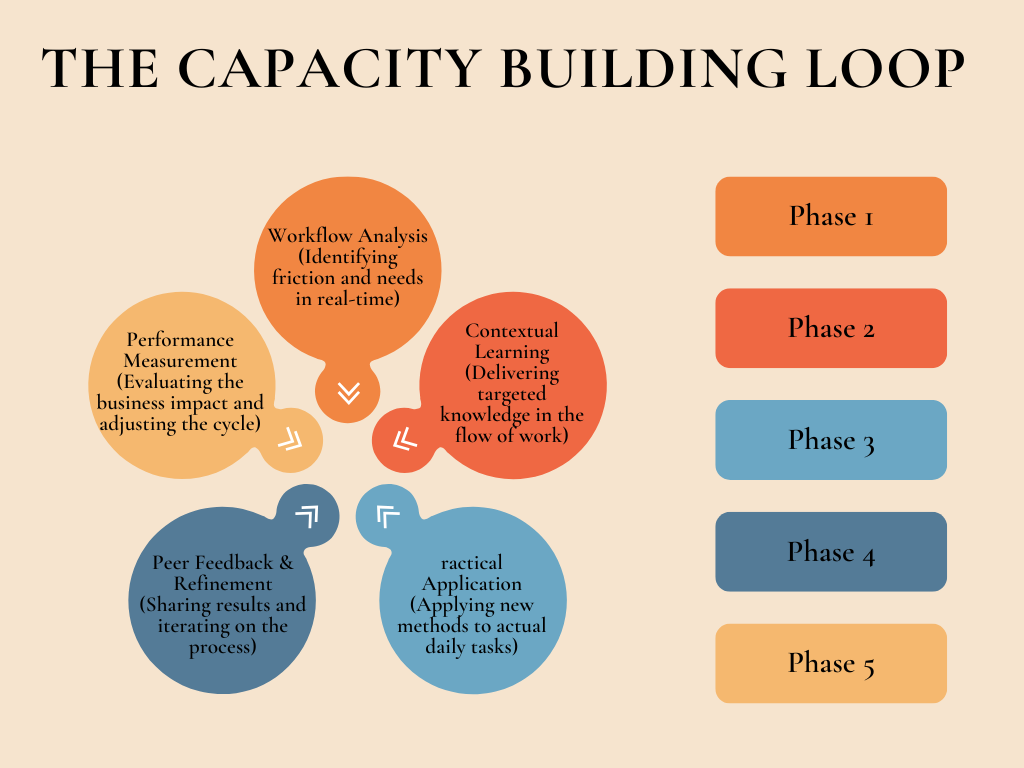
- Phase 1: Workflow Analysis (Identifying friction and needs in real-time)
- Phase 2: Contextual Learning (Delivering targeted knowledge in the flow of work)
- Phase 3: Practical Application (Applying new methods to actual daily tasks)
- Phase 4: Peer Feedback & Refinement (Sharing results and iterating on the process)
- Phase 5: Performance Measurement (Evaluating the business impact and adjusting the cycle)
Building a Future-Ready Organizational Culture
The ultimate goal of redefining L&D is to build an organizational culture that is inherently adaptable. This goes beyond the HR department; it is a fundamental leadership responsibility.
Leaders must actively sponsor and participate in capacity-building initiatives. When executives prioritize their own continuous development, it sends a clear message throughout the company. Learning must be viewed as a critical business strategy, not an optional perk.
When organizations embrace a mindset of continuous knowledge expansion and technological adaptation—much like the core mission we drive at Twin Owl—they unlock true resilience. They stop reacting to every new technological trend with panic and start approaching change with calculated confidence.
We must also align our recruitment and talent management strategies with this new paradigm. We should prioritize hiring individuals who demonstrate high cognitive flexibility and a strong desire to learn, rather than just matching a static list of technical requirements.
Furthermore, performance evaluations should reflect this shift. Employees should be recognized and rewarded not just for their output, but for their ability to acquire new competencies, share knowledge with their peers, and adapt their workflows to improve efficiency over time.
Redefining the Professional Approach
This shift also demands a transformation for the professionals orchestrating these changes. The role is no longer about just designing curriculum or facilitating workshops in a vacuum.
The modern approach requires a strategic business partner, a performance consultant, and an orchestrator of learning ecosystems. Professionals driving this change must possess strong business acumen to align learning initiatives with company objectives. They need analytical skills to interpret performance data and adjust strategies continuously.
They must also become experts in the very technologies they are helping the organization adopt. A team cannot effectively build AI capacity if they are still relying entirely on manual, legacy processes to design and deliver their own programs. By adopting these tools internally, leaders can model the exact behavior they wish to see across the broader workforce.
The Path Forward
The distinction between training and capacity building is not just a matter of semantics. It represents a fundamental choice in how an organization values and develops its human capital.
Continuing to rely on isolated, event-based training in the face of rapid technological advancement is a recipe for stagnation. It leaves employees frustrated, limits organizational agility, and ultimately degrades your competitive advantage in a crowded market.
We must move beyond the slide deck. We must stop trying to teach people how to use a specific version of a tool, and start empowering them with the adaptable mindset needed to thrive alongside complex, evolving systems.
By committing to continuous capacity building, organizations can ensure that their workforce does not merely survive the AI era, but actively shapes and drives it forward. It is time to treat learning not as an isolated event, but as the very foundation of organizational survival and success.