Event Theme: Acceleration = Context × Intelligence
There was one message repeated throughout the meetup.
AI is becoming more powerful, but intelligence alone isn’t enough. The real differentiator is context.
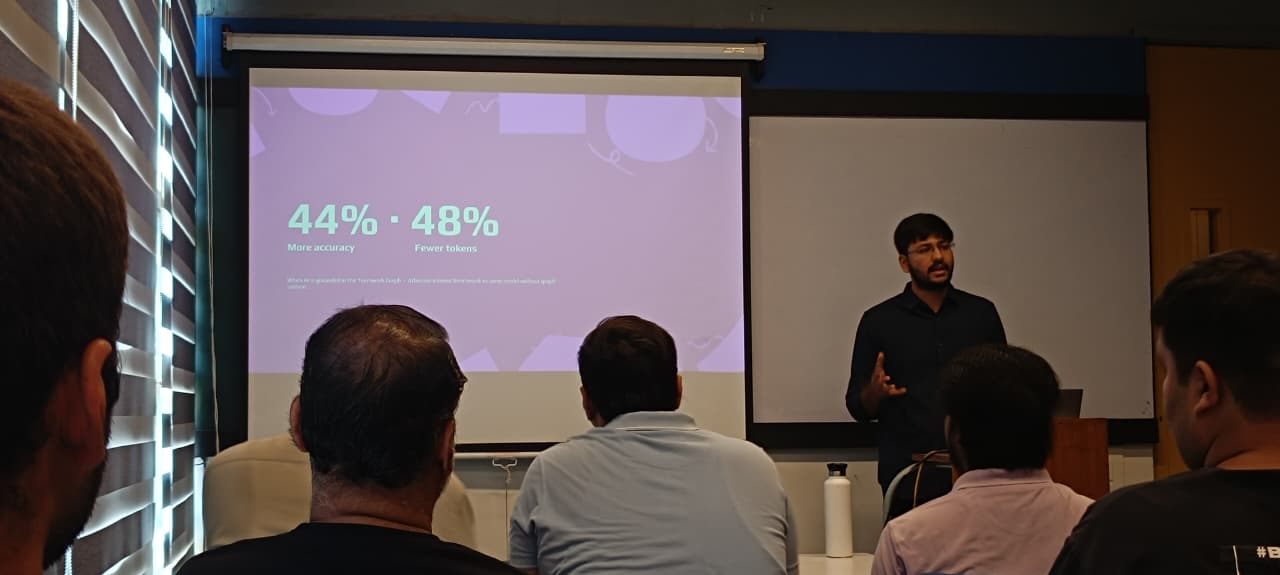
Almost every product announcement—from Jira and Rovo to Service Management and Software Collection—was built around one common foundation: Teamwork Graph. Atlassian’s vision is no longer to add AI features into products. Instead, it wants every product to understand organizational context so AI can take meaningful action.
Here are my field notes from the meetup.
Chapter 1: Context Is Becoming the Competitive Advantage
The session started with an interesting idea.
AI without context is just another chatbot.
Atlassian is opening Teamwork Graph so developers and organizations can build AI experiences grounded in company knowledge instead of isolated prompts.
Some notable announcements included:
- Teamwork Graph becoming more accessible
- Teamwork Graph CLI (Open Beta)
- Forge Connectors GA
- Rovo Studio as a 100% no-code AI builder
- Max Mode in Rovo Chat
- Code Intelligence
- Autonomous Agents
- Agent Versioning
- Rovo Skills
- Import & Export Agent Configuration
- Enterprise AI Governance
The biggest takeaway
Context is becoming the moat.
Instead of AI searching through documents manually, it understands relationships between Jira issues, Confluence pages, repositories, documentation, permissions, people, and workflows.
That dramatically improves both relevance and accuracy.
Possible use case
A developer can ask Rovo to understand a Jira issue, review connected documentation, inspect related repositories, identify the affected code, recommend changes, and prepare implementation before asking for final approval.
For marketing teams
Imagine connecting campaign briefs, documentation, analytics, customer feedback, and project tasks into one knowledge graph. Instead of searching across multiple tools, AI can answer with organization-specific context.
Chapter 2: Service Collection Is Moving Toward Autonomous IT
The second chapter focused on AI-powered service management.
Announcements included:
- Rovo Service
- Incident Command Center
- Solution Composer
- Assets Data Manager v2
- Expanded Service Collection
The vision is simple.
Employees should spend less time opening tickets and more time getting work done.
Instead of asking multiple teams for software access, onboarding steps, hardware requests, or documentation, employees can simply ask an AI teammate.
The biggest takeaway
Service is becoming conversational.
AI doesn’t just answer questions—it can complete approved actions across connected systems.
Possible use case
A new employee joins the organization.
Instead of contacting HR, IT, Finance, and the manager separately, Rovo can guide onboarding, collect required documents, provision software, assign hardware, answer policy questions, and track progress automatically.
Chapter 3: Teamwork Collection Makes Jira More Agentic
This chapter introduced how AI will work directly inside Jira and collaboration tools.
Announcements included:
- Agents in Jira
- AI Planner
- Create with Rovo in Jira
- Individual Capacity Planning
- Guest Access for Jira
- Confluence Slides
- Loom Bug Reporting
- Loom Meeting to Jira
- Loom Data Residency
Rather than using AI as a separate assistant, Atlassian is embedding AI into everyday project work.
The biggest takeaway
AI is becoming another teammate inside Jira.
Teams can assign work directly to AI agents, include them in workflows, and let them automate repetitive execution while maintaining audit trails.
Possible use case
After a meeting ends, Loom automatically summarizes discussions, creates Jira issues, recommends next actions, updates project boards, and notifies the right people.
No manual note-taking required.
For project managers
Sprint planning becomes easier because AI understands workload, history, dependencies, and team capacity before suggesting work assignments.
Chapter 4: Product Teams Get AI-Powered Decision Making
Product teams received several announcements around customer feedback and planning.
Highlights included:
- Feedback (Early Access)
- Pendo Integration
- Agentic Roadmapping
Instead of manually collecting feedback from multiple sources, AI continuously analyzes customer conversations, usage data, and product insights.
The biggest takeaway
Roadmaps become evidence-driven instead of opinion-driven.
Product managers spend less time collecting information and more time making decisions.
Possible use case
Customer feedback from support tickets, surveys, usage analytics, and conversations automatically surfaces product opportunities and suggests roadmap priorities.
Chapter 5: Software Collection Brings AI Closer to Development
This chapter focused on software engineering.
Announcements included:
- Native Task-to-Code
- AI Coding Automation
- AI Code Review
- Agentic Bitbucket Pipelines
Developers can increasingly move from planning to implementation without constantly switching between tools.
The biggest takeaway
Context travels with the developer.
Instead of copying Jira tickets into IDEs, AI already understands requirements, documentation, linked discussions, and repositories.
Possible use case
A Jira issue can be converted into code suggestions, reviewed by AI against coding standards, validated, and prepared for deployment while keeping developers in control of approvals.
Chapter 6: Strategy Collection
Although fewer product details were shared during this section, the direction was clear.
Business strategy, planning, execution, and operational intelligence are gradually being connected through the same AI platform.
Instead of managing disconnected planning documents, organizations can align strategic goals with execution happening across Jira, Confluence, Service Management, and Software teams.
The biggest takeaway
Strategy is gradually becoming connected to day-to-day execution through shared organizational context.
What Stood Out Most
Across every announcement, one pattern became obvious.
This wasn’t about releasing another AI chatbot.
It was about building an AI-native organization where agents understand company knowledge before taking action.
Three ideas appeared repeatedly throughout the event:
- Context powers intelligence. Teamwork Graph is becoming the foundation behind almost every AI capability.
- Agents execute work, not just generate text. AI is moving from answering questions to completing approved tasks.
- Governance remains essential. Features like agent versioning, audit logs, permissions, hosted LLMs, and enterprise governance show that trust is being built alongside automation.
Authors take as Marketers
While many announcements focused on engineering and IT, several ideas also apply to marketing teams.
- AI agents could connect campaign briefs, analytics dashboards, content documentation, and project management into one searchable knowledge layer.
- Teamwork Graph could help marketers retrieve accurate campaign context instead of searching across multiple tools.
- AI-generated meeting summaries, documentation, and planning can reduce repetitive coordination work.
- Better organizational context can improve collaboration between marketing, product, engineering, and customer success teams.
The long-term opportunity isn’t simply faster content creation—it’s faster decision-making supported by trusted organizational knowledge.
Final Thoughts
The biggest shift from this meetup wasn’t a single feature announcement.
It was the change in philosophy.
Earlier generations of AI helped people create content.
The next generation appears focused on understanding work, collaborating with teams, and executing tasks using organizational context.
If this direction continues, AI may become less of a tool that employees open and more of a teammate that works alongside them inside the products they already use every day.
Also Read: Notes from the Field: CSQA AgentiX 2026 — Inside IBM’s Agentic QA Meetup
AI Disclosure: This article was drafted with AI assistance using firsthand event notes and supporting research. The content has been thoroughly reviewed, fact-checked, and edited by The Twin Owl team before publication.