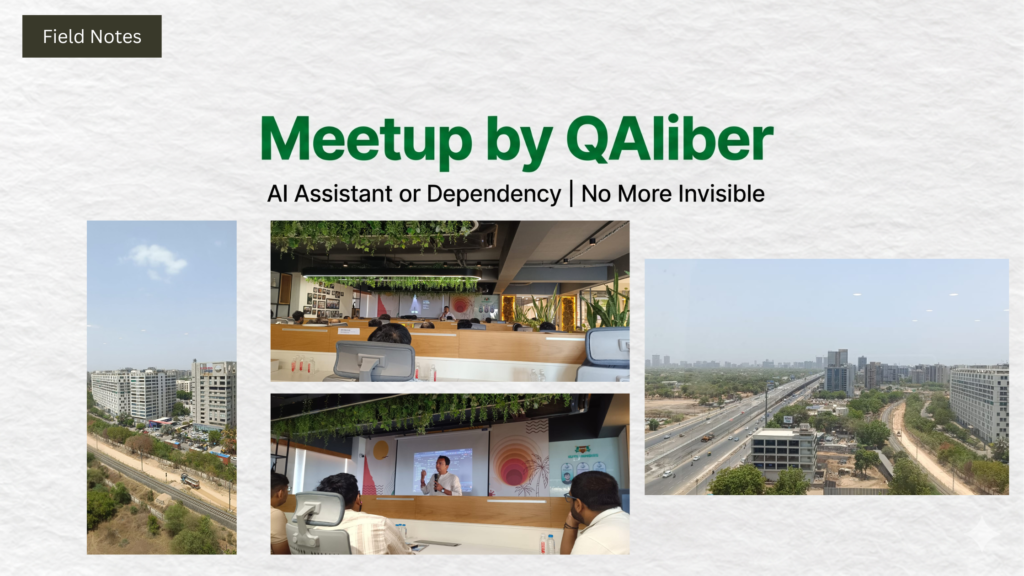
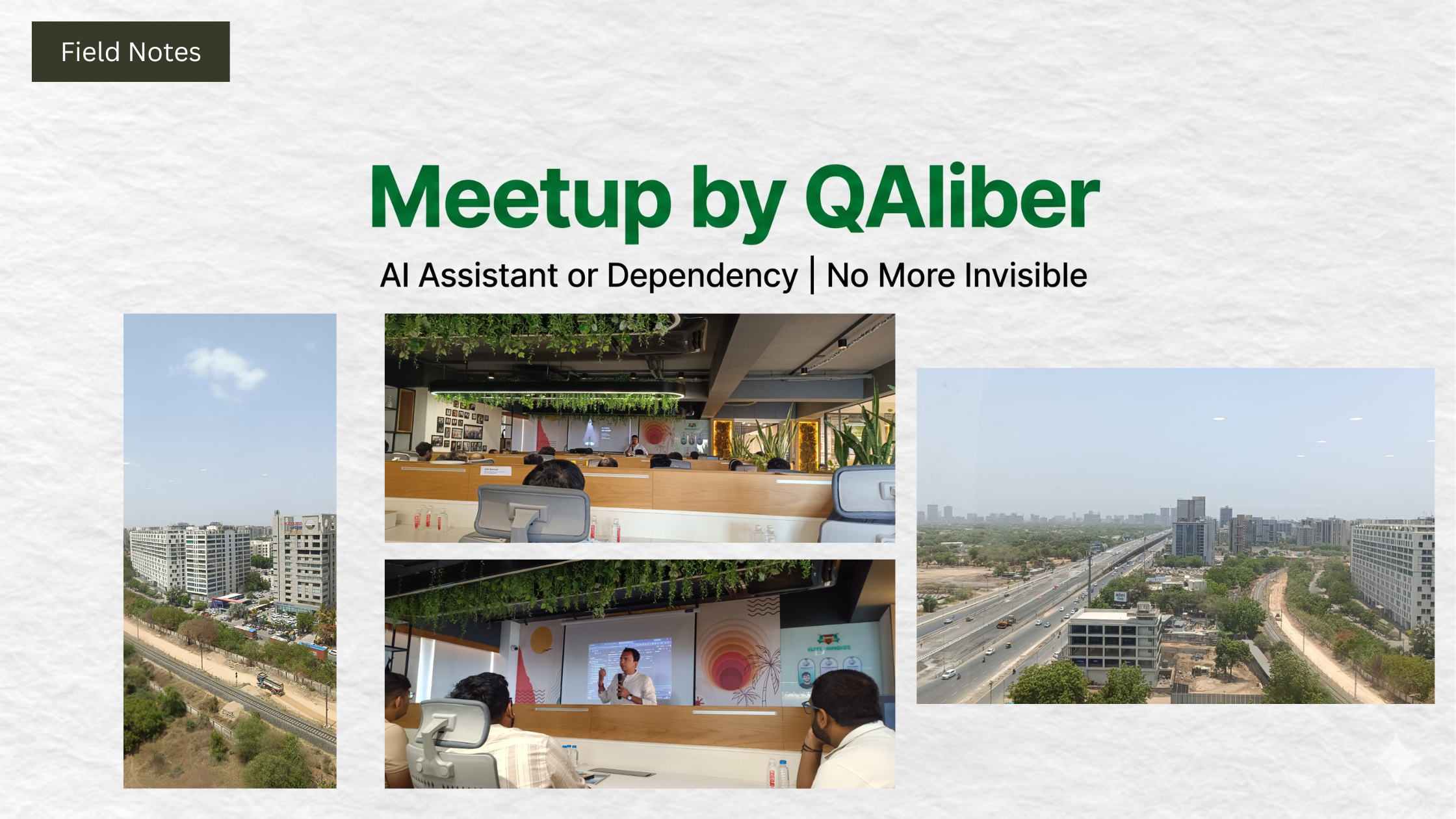
QAliber Community Meetup —
notes from the room
An interactive session that brought QA professionals together to talk honestly about two things the industry tends to avoid: how we’re actually using AI, and why QA keeps getting overlooked despite being one of the most business-critical functions in any product team.
Every once in a while, you walk into a room and the conversation is exactly the one the industry needed to be having. Today’s QAliber meetup was one of those. Two sessions. Two speakers. Completely different angles — but by the end, both were pointing at the same uncomfortable truth: QA professionals are underestimating themselves, and the tools around them, in ways that cost everyone.
The session opened with a question that felt simple but landed hard: is AI improving your thinking, or replacing it? Because there is a meaningful difference — and most QA teams are sliding toward the wrong answer without realising it.
The talk walked through what experienced QA engineers do before AI enters the picture. The full process — requirements review, analysis, test design, execution — exists for a reason. Each step is where the actual thinking happens. Where edge cases surface. Where a tester’s instinct about “what could go wrong here” gets captured before it becomes a production incident.
What happens when AI jumps in too early? You get execution without understanding. The live demo made this viscerally clear: feed a vague prompt into an AI, and you get vague test cases. The AI is not the problem. The missing thinking before the prompt is. The room then watched a walkthrough of how to use AI intelligently in QA — feeding it well-defined requirements, real-world user scenarios, and specific constraints. The difference in output quality was significant enough that several people pulled out their phones to take notes.
- Think — understand the requirement fully before touching any tool
- Ask — frame a precise, context-rich prompt grounded in real user scenarios
- Verify — treat AI output as a first draft, not a final answer
- Learn — use what the AI surfaces to sharpen your own mental model
The key insight from the room: AI does not remove the need for QA expertise. It raises the bar for it. A vague tester with AI is still a vague tester — just a faster one. A sharp tester with AI becomes genuinely formidable.
Session two opened with an invitation most QA engineers do not give themselves permission to accept: celebrate your wins. Fixed a critical bug before it hit production? That is worth acknowledging — loudly, professionally, visibly. Not for ego. For the team, for the business, and for a function that will always struggle to justify its seat at the table if it only speaks up when something goes wrong.
The talk laid out, with uncomfortable clarity, why QA teams consistently end up invisible in organisations where they are doing irreplaceable work. The room recognised itself in the patterns almost immediately.
“One bug in production can cost a business millions. One failed feature can destroy customer trust built over years. QA is not a support function — it is a revenue protection function.”
The session framed QA’s real business impact across four dimensions that rarely get communicated upward:
- Revenue — a single production bug can trigger millions in losses, refunds, and churn
- Trust — a failed feature does not just disappoint users, it erodes the brand
- Production stability — systems that run reliably at 2am do so because of QA
- Panel reporting — QA data is some of the most honest signal in the product lifecycle
The session then introduced the five shifts — a mindset reframe for QA professionals ready to stop being the last people consulted and start being part of the first conversation.
The turning point the session built toward was quality leadership — not just being involved in testing, but being part of production decisions, release strategy conversations, and risk discussions at the table where those calls actually get made. The message was direct: if QA is not in that room, the room is making worse decisions. And it is partly QA’s responsibility to get there.
Two sessions. Two very different topics. But the same underlying message ran through both: QA professionals have more leverage than they are using — over their tools, their output, their visibility, and their seat at the business table. Today was a reminder that community conversations where these things get said out loud are rare, and worth showing up for.